How to Choose the Right Tow Dolly (And Why It’s Worth Getting Right)
A dolly failure doesn’t happen on a good day. It happens mid-recovery, on the shoulder, with a truck stacked up behind you and a customer watching. If you’re trying to figure out how to choose a tow dolly for your fleet, or wondering if the one you’re running is actually rated for what you’re asking it to do, here’s what actually matters, and where the two lines we carry, Collins and In The Ditch, fit in.
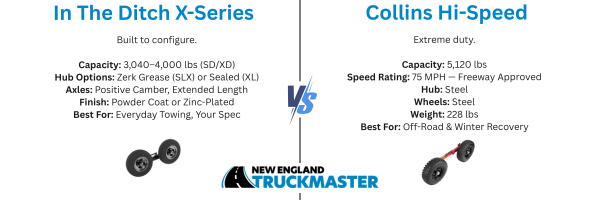
What Actually Matters When You’re Choosing a Tow Dolly
Capacity. Every dolly is rated for a max load, and it’s not just about the vehicle’s curb weight. Terrain, speed, and how hard you’re loading it matter too. Understanding tow dolly capacity ratings before you buy is how you avoid blown tires and bent frames, usually at the worst possible time. Running near or over the rated limit is a common (and preventable) cause of equipment failure.
Duty cycle. A dolly that spends its life on quick, flat, in-town tows has a very different job than one doing long highway runs or off-road recoveries in New England winters. Match the build to the work, not just the price tag.
Hub type. This is the maintenance question nobody thinks about until it costs them a Saturday. Some dollies need routine grease at a Zerk fitting, others use a sealed, automotive-grade hub that’s built to go maintenance free for the long haul. Neither is “wrong.” It depends on whether you’d rather grease it or forget about it.
Axle and camber design. Positive chamber axles preload the dolly once a vehicle is loaded, which improves stability in transit and extends tire life. It’s a small spec line that has a real effect on how long your tires, and your dolly, actually last.
Mount compatibility. A great dolly on the wrong mount is a headache every single tow. Confirm fit for your specific truck before you buy, not after.
The Two Lines We Carry
Collins Hi-Speed® — including the G7X Super Dolly
Collins built its reputation on the Hi-Speed platform, and the G7X Super Dolly is the heavy-duty end of that lineup. The G7X was originally engineered for off-road winter recovery work and built to keep going where a standard dolly gives up. If you’re looking for the best tow dolly for wreckers running extreme-duty recoveries, off-road pulls, and high-mileage highway tows, this is where to start.
- Steel hubs and high-capacity steel wheels for durability under repeated heavy loads
- Wider T12 Hybrid Cross Rails — aluminum outer rails with a zinc-plated steel insert
- Load range E tires for an industry-leading 5,000 lb capacity
- 75 MPH speed rating and freeway-approved for interstate use. Collins tests its Hi-Speed dollies to 1,600 freeway miles over the course of a single tow, with no towing-distance restrictions
- Safety Ratchet System built into the Hi-Speed platform, designed to let operators safely raise heavy vehicles, lift against a wall, and work on snow, ice, gravel, and slopes. It also acts as a secondary safety system to help prevent a vehicle from dropping
- 228 lbs — heavy-duty capacity without the weight of a bulkier build, which matters when someone’s manually loading it every shift
In The Ditch X-Series™
The X-Series is the more configurable option. In The Ditch built it around choices, so you can match it to how your shop actually runs.
- Choose your hub: Speed® Lube (SLX) uses a Zerk fitting for quick, routine lubrication; eXtended Life (XL) is a sealed, automotive-grade hub that’s built to go essentially maintenance-free.
- Choose your capacity: Standard Duty (3,040 lbs) for lighter, everyday tows, or Extreme Duty (4,000 lbs) for heavier loads.
- Positive Camber XL Axles, now longer than previous generations, with added Snap Button Holes for greater adjustability. The camber design preloads the dolly under load — better stability, longer tire tread life.
- Exclusive aluminum rims rated to 100 psi with a 1,000 lb carrying capacity, plus your choice of ITD Endurance™ powder coat or zinc-plated finish.
- A breakover-bar design built for tight spaces, useful for when you’re wedged between parked cars with no room to swing a bar all the way back.
Between the two duty tiers and two hub options, the dollies from In The Ditch covers a wider range of day-to-day towing needs than most single-spec dollies on the market. Check current X-Series stock and specs on our online store.
Why Buy Local Instead of Ordering One
You can find both of these brands in online towing catalogs. Here’s what a catalog page can’t do for you:
You can see it before you buy it. A dolly set is a big investment and a bigger piece of equipment to have show up wrong. Roll it, check the breakover, confirm it fits your trucks, before it’s yours.
No freight risk. Heavy equipment shipped by truck freight is exactly the kind of thing that gets damaged, delayed, or shows up missing hardware. Buy it here and it goes straight from our floor to your truck.
We know how it mounts on your rig. Compatibility isn’t one-size-fits-all. We can talk through fit for your specific trucks, not just sell you a SKU.
You’re supported by people who service what they sell. Need a part down the road? You’re calling a shop that knows the equipment, not a call center reading from a manual.
It’s ready when your truck is down. When a dolly fails mid-recovery, “3-5 business days” isn’t an option. Same day delivery or swing by Plainville and we will get you one the same day.
Come Compare Them in Person
The right dolly depends on your fleet, your terrain, and how you’d rather maintain it. Stop by New England TruckMaster to see both the Collins Hi-Speed G7X and the In The Ditch X-Series side by side, and we’ll help you match the spec to the job. Contact us at 800-481-0501 to check current stock or for help on what dolly is best for you.
FAQs
What’s the difference between Standard Duty and Extreme Duty dollies? Standard Duty (SD) dollies are built for lighter, everyday tows. In The Ditch rates its SD line at 3,040 lbs. Extreme Duty (XD) dollies use heavier construction to handle bigger loads, rated up to 4,000 lbs on the X-Series. The right choice comes down to the typical weight of what you’re towing, not just what’s cheapest up front.
Do I need a sealed hub or a Zerk fitting? It’s a maintenance trade-off, not a durability one. A Zerk (grease) fitting, like In The Ditch’s Speed® Lube (SLX) hub, needs routine greasing to stay in good shape but is simple and familiar to most shops. A sealed, automotive-grade hub, like In The Ditch’s eXtended Life (XL) hub, is built to run essentially maintenance-free. If your dollies tend to get neglected on the maintenance schedule, a sealed hub removes that risk.
How much weight can a tow dolly actually carry? It depends on the model. In The Ditch’s X-Series ranges from 3,040 lbs (Standard Duty) to 4,000 lbs (Extreme Duty), while the Collins G7X is built for heavier-duty use with a 5,000 lbs capacity rating. Always check the dolly’s rated tow dolly capacity against the actual curb weight of the vehicles you’re towing, not just the class of vehicle, and build in a safety margin for terrain and speed.
What’s the best tow dolly for wreckers doing off-road or winter recovery work? For extreme-duty conditions, like off-road recoveries, high-mileage highway runs, and harsh New England winters, the Collins G7X Super Dolly is purpose-built for that use case, with steel hubs, high-capacity steel wheels, and a 75 MPH speed rating.
Does camber design actually matter, or is it a marketing spec? It matters. Positive camber axles preload the dolly once a vehicle is loaded, which improves in-transit stability and extends tire tread life. Over the life of a dolly, that’s fewer tire replacements and a more predictable tow.